Category: Built Environment

  • The Hidden Cost of Preventable Injuries: How Prevention Gets Ignored Until Crises Hit

    The Hidden Cost of Preventable Injuries: How Prevention Gets Ignored Until Crises Hit

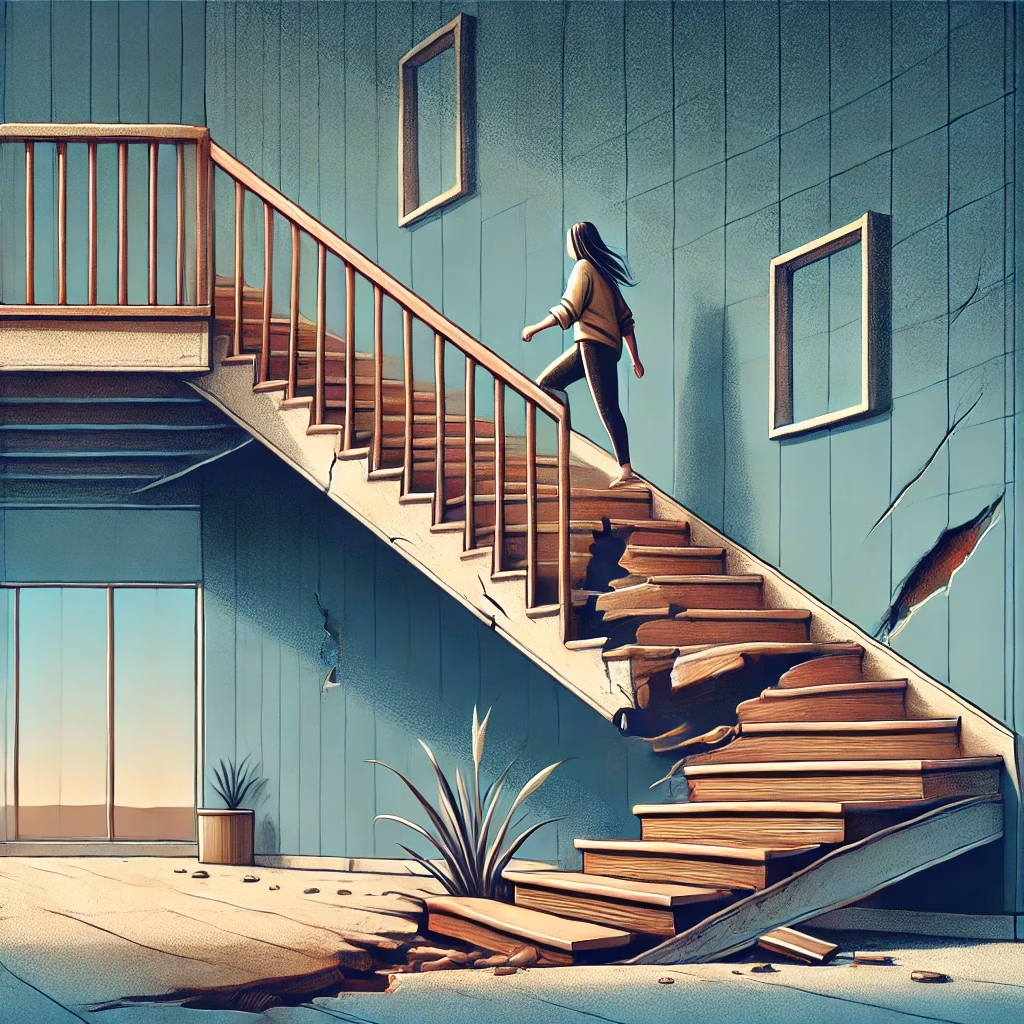
    You know that squeaky stair in your grandma’s house that everybody just “learns to skip”?

    The one where your whole family’s got an unspoken system:

    • “Just hop over the third step”
    • “Lean to the right when you hit that spot”
    • “Don’t step there after midnight”
    • “Make sure you tell your friends about the trick before they visit”

    We all got that stair. And we all got that complex dance to avoid the consequences.

    But here’s something that’ll make you think – what we call “accidents” in America ain’t random at all.

    They’re predictable.
    They’re preventable injuries, and designed into our environment as surely as that squeaky stair was built into your grandma’s house.

    The Mathematics of “Random” Events

    Let me tell you about one of public health’s dirty little secrets: what most people call “accidents,” we call “preventable injuries” – and there’s nothing accidental about the patterns.

    Check the numbers:

    • Preventable injuries are the leading cause of death for Americans ages 1-44
    • The top three killers? Motor vehicle crashes, poisoning (including overdoses), and falls
    • Every year, about 39.5 million people seek medical attention for injuries
    • The economic burden? Over $4.2 trillion annually

    Does that sound random to you? Because to public health folks, that sounds like a pattern. Like a system.

    Think about this – we can literally predict how many “random” drownings will happen this summer.

    We can forecast how many “accidents” will happen on a particular stretch of highway.

    We can estimate how many kids will fall from a specific type of playground equipment.

    That’s not randomness. That’s a design flaw we’re choosing to live with.

    The Life-Course of Risk: How Age Shapes Our Danger

    Just like that squeaky stair hits different depending on who’s trying to navigate it, injury risks transform as we age. What’s deadly at two months isn’t what’s deadly at two years or twenty years.

    Infants: The Suffocation Crisis No One’s Talking About

    For our smallest humans, the biggest killer isn’t disease – it’s suffocation. Soft bedding, loose blankets, shared sleeping surfaces. Things that seem comforting become deadly when paired with babies who can’t yet roll over or move their heads.

    But here’s what public health sees: these aren’t “tragic accidents” – they’re predictable, preventable deaths that follow clear patterns. And the patterns aren’t equal:

    • Black infants die of accidental suffocation at over twice the rate of white babies
    • Lower-income families face higher risks, often living in cramped housing with limited access to safe sleep spaces
    • Education alone doesn’t fix structural problems – you can’t put your baby in a crib you can’t afford

    This is what I mean about systems, not just behaviors. We keep telling parents “back to sleep” while ignoring the economic realities that make that simple advice impossible for some families to follow.

    Children: Drowning in Inequality

    As kids start moving, water becomes the silent threat. Drowning kills more children 1-4 than anything except birth defects. But this crisis hits communities with dramatically different force:

    • Black children drown at 3.6 times the rate of white children
    • Swimming lessons reduce drowning risk up to 88%
    • Yet access to pools, swimming education, and water safety resources follows predictable patterns of racial and economic segregation

    Here’s what hits different: we frame this as “Black kids don’t know how to swim” instead of “we’ve systematically denied Black communities access to pools, swimming education, and water safety for generations.” We blame the victims instead of examining why some communities have three public pools while others have none.

    That’s not individual failure – that’s system design.

    Teens: Driving While Developing

    For teenagers, it’s all about vehicles. Car crashes remain the leading killer of teens, with 2,400 deaths yearly. The frontal lobe – responsible for risk assessment, impulse control, and decision-making – isn’t fully developed until 25. We hand keys to powerful machines to people whose brains are literally still under construction.

    This is where prevention has actually made some headway:

    • Graduated driver’s license programs have reduced teen crash fatalities by 20%
    • Restricted night driving, passenger limits, and extended learning periods save lives
    • However, these programs primarily benefit those who can afford formal driver’s education

    The stair is squeaking loudly here, and we’ve started to fix it – but only for those who can access the repair services.

    Young Adults: The Overdose Generation

    As we move into young adulthood, the killer shifts from the roads to what’s flowing through our veins. Overdose deaths have skyrocketed, becoming the leading cause of injury death for Americans 25-44. In 2021 alone, over 100,000 Americans died from overdoses.

    But this ain’t just about “bad choices” or “addiction” – it’s about systemic failure on multiple levels:

    • Pharmaceutical companies flooded communities with opioids while downplaying risks
    • Treatment remains inaccessible for millions who need it
    • Harm reduction strategies proven to save lives face political opposition
    • Racial disparities in enforcement mean some users get treatment while others get prison time

    The cruelest part? We know what works:

    • Naloxone distribution programs reduce overdose deaths by 21%
    • Medication-assisted treatment cuts mortality rates by 50-70%
    • Supervised consumption sites reduce ambulance calls and hospitalizations

    But we’re still stuck in a morality debate while people die from a thoroughly preventable cause. We’re arguing about whether people “deserve” help while the stair keeps breaking beneath their feet.

    Adults: The Working Wounded

    Once we’re fully in the workforce, our jobs become our biggest injury threat. From construction falls to healthcare back injuries to office repetitive strain, our workplaces are constantly trying to break us down.

    OSHA has reduced workplace deaths from 38 to 15 daily since 1970, but that improvement masks deep disparities:

    • Latinx workers are 50% more likely to die from workplace injuries
    • Temp workers receive 65% less safety training than permanent employees
    • Low-wage industries face the highest injury rates but the lowest inspection rates

    The squeaky stair in the workplace has been reinforced for some offices, but in many warehouses, factories, and fields, it’s still crumbling – by design.

    Older Adults: The Fall that Changes Everything

    For seniors, a single fall can cascade into permanent disability or death. Over 36,000 older Americans die from falls annually, and millions more face life-altering injuries.

    The prevention gap is striking:

    • Home modification programs can reduce falls by 39%
    • Basic interventions like grab bars, improved lighting, and removal of trip hazards save lives
    • Medicare often covers fall treatments but not the full cost of prevention—except in some Advantage plans.

    We’d rather pay for the ambulance at the bottom of the hill than the fence at the top. We’d rather cover the surgery after the fall than prevent the fall in the first place.

    Design Problems vs. Behavior Problems

    America loves to frame systemic problems as individual failings.

    Can’t afford healthcare? Must be your spending habits. Got injured at work? Should’ve been more careful. Kid fell off the playground? Should’ve watched them better. Overdosed on opioids? Shouldn’t have started using in the first place.

    We’re living in a system that tells us safety is a personal choice rather than a public responsibility.

    But let’s be real about something: not all staircases are created equal.

    • Some neighborhoods got whole staircases falling apart – with rotting wood, missing railings, and steps that give way without warning
    • Others got brand new steps with backup railings, non-slip surfaces, and maintenance teams on standby
    • And we keep telling people “just be more careful” instead of fixing the damn stairs

    The Inequity of Injury

    If you think unintentional injuries hit all communities equally, let me redirect your thinking right now.

    Low-income communities face injury rates up to 2-5 times higher than affluent areas. Black and Indigenous children drown at rates 2-3 times higher than white children. Rural residents are nearly twice as likely to die from unintentional injuries as urban residents.

    Here’s what hits different: When a white suburban kid overdoses, communities mobilize for awareness campaigns and increased treatment options. When the same thing happens in a poor Black neighborhood, we call for more policing. Same problem, entirely different response based on who’s suffering.

    Because let’s be real:

    • Some communities can’t afford to fix that squeaky stair
    • Others don’t own the building and can’t make changes
    • Many are working multiple jobs and don’t have the luxury of constant vigilance
    • And the landlord keeps saying it’s “good enough” until somebody falls through

    This ain’t about telling people to “be more careful” – it’s about building systems where care isn’t the only thing standing between a person and disaster.

    The Hidden Economics of Prevention

    You want to know why we keep dancing around that squeaky stair instead of fixing it? Two words: deferred costs.

    It’s cheaper in the short term to ignore the problem. It’s easier to put a little sign saying “Skip this step” than to replace the whole staircase. It’s more politically expedient to fund emergency rooms than prevent the emergencies in the first place.

    But here’s the financial reality:

    • Every $1 spent on smoke alarms saves $69 in fire costs
    • Every $1 spent on bicycle helmets saves $29 in medical costs
    • Every $1 spent on childproof medicine packaging saves $75 in poison control costs
    • Naloxone programs can save thousands per prevented overdose

    Prevention ain’t just morally right – it’s economically brilliant. Yet we keep choosing the expensive emergency over the affordable prevention because the costs hit different budgets. We keep choosing individual warnings over systemic redesign.

    The healthcare system alone spends over $136 billion annually treating injuries that shouldn’t have happened in the first place. That’s not fiscal responsibility – that’s fiscal malpractice.

    The Invisible Infrastructure of Safety

    Let me tell you why you don’t think about injury prevention – because when it works, it’s invisible.

    You don’t thank the building code that requires handrails on your stairs. You don’t celebrate the car seat that kept your baby safe during a fender bender. You don’t write love letters to the automatic shut-off on your space heater.

    Public health prevention works in the background, silent and unnoticed, until it’s not there. Then we call the resulting injuries “tragic accidents” rather than “predictable consequences of preventable system failures.”

    Think about it:

    • When was the last time you actively appreciated that your medication came in a childproof container?
    • Have you ever sent a thank-you note to the person who designed the automatic shut-off on your iron?
    • Did you vote for your local representative based on their stance on playground safety standards?

    We don’t see prevention, so we don’t value it. We don’t fund it. We don’t demand it. And people keep getting hurt in ways that weren’t accidents at all – they were design decisions.

    The Injury Prevention Revolution

    Public health doesn’t just teach people the “skip-that-step dance.” We’re out here trying to rebuild these staircases before somebody who doesn’t know the family routine takes a wrong step.

    What would a real commitment to injury prevention look like?

    • Universal housing standards that prevent falls regardless of income
    • Transportation systems designed for humans, not just vehicles
    • Product safety as a requirement, not a luxury feature
    • Widespread access to overdose reversal medications and treatment
    • Data-driven identification of injury patterns before they become statistical trends
    • Community-led interventions that address local risk factors
    • Policy that prioritizes prevention over post-crisis reaction

    Because preventing injuries isn’t just about saving lives – though it absolutely does that. It’s about creating communities where everyday life doesn’t require constant vigilance just to stay safe.

    The New Safety Conversation

    Next time somebody says “accidents just happen,” remind them: That stair’s been squeaking at us for years. And when it finally gives out? It won’t care if you knew the family routine or not.

    The truth is, most “accidents” aren’t accidents at all. They’re the predictable results of:

    • Systems we’ve designed poorly
    • Risks we’ve decided are acceptable
    • Costs we’ve chosen to defer
    • Safety measures we’ve decided some communities don’t deserve

    The question isn’t “why wasn’t that person more careful?”

    The question is “why do we accept a society where staying alive requires so much careful?”

    Because the most expensive injury is always the one we could have prevented but chose not to.
  • Environmental Health Crisis: How Earth’s Breaking Point Threatens Public Health

    Environmental Health Crisis: How Earth’s Breaking Point Threatens Public Health

    Like the Wu Tang Clan, environmental health ain’t nun to fuck with.

    via GIPHY

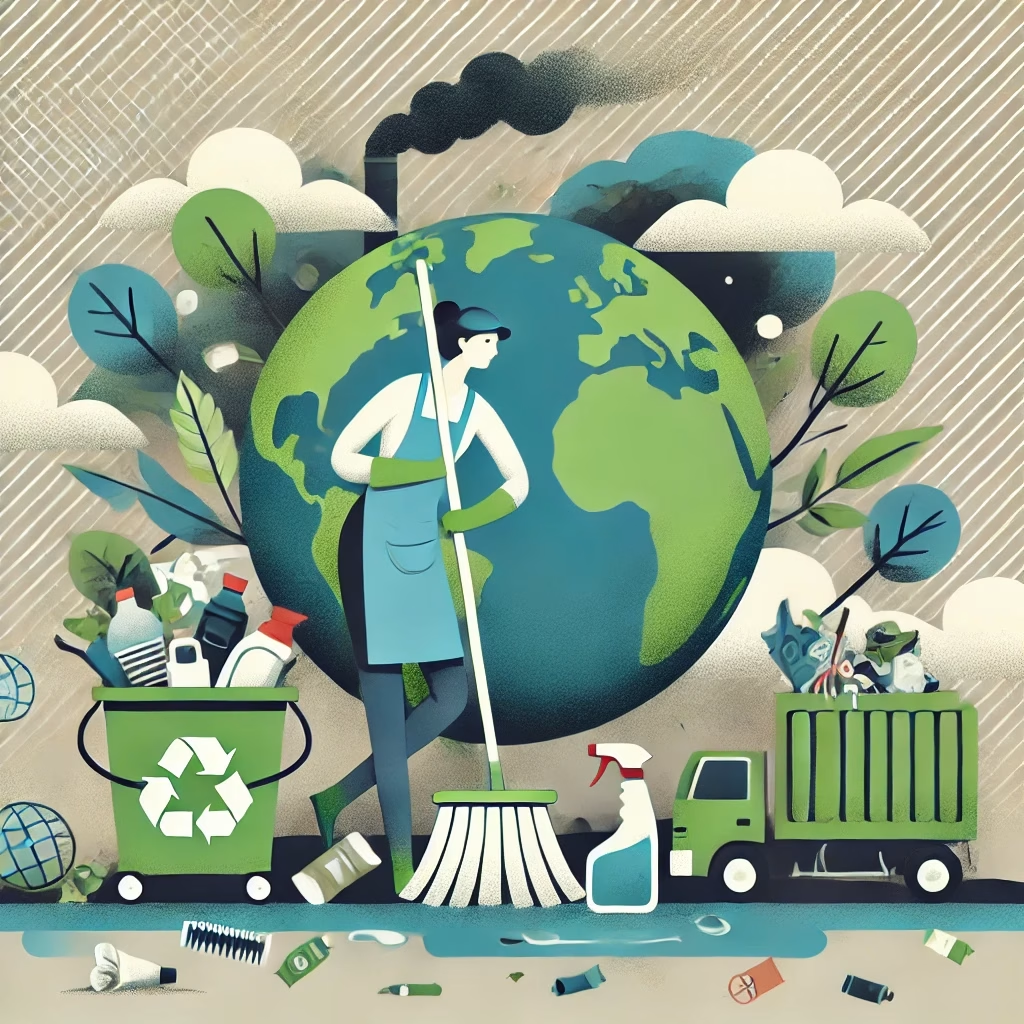
    The Earth’s been our janitor since day one, cleaning our air, filtering our water, and absorbing our mess. But we’re acting like entitled tenants who think cleanup is just “part of the job.”

    And let me tell you – this ain’t working out like we thought it would.

    The Original Cleanup Crew

    Back in the early 1900s, Americans were living rough. Drinking dirty water, eating contaminated food, sharing space with disease-carrying critters – and dying from it.

    No antibiotics, no vaccines, just pure environmental chaos.

    When you got a mess in your building, you generally got two choices:

    • Clean it up,
    • Let it pile up until everybody gets sick

    Our ancestors figured this out the hard way.

    By 1940, they’d dropped infectious disease deaths by 75% – not with medicine, but by improve their environmental condition.

    • Building water systems that actually worked
    • Getting the rats out before the plague got in
    • Making sure food wasn’t trying to take you out

    That was the birth of environmental health – when we finally realized we needed better building maintenance.

    The Laws of the Building (Barry Commoner’s Truth)

    In the 1970s, this homie named Barry Commoner came through and laid down four laws about how our building actually works. An environmental health manual if you will:

    1. Everything Is Connected to Everything Else
      • You can’t just mess up one room and think it won’t affect the whole building.
      • That smoke you’re pumping into the air? It’s coming back in your water.
      • Those chemicals you’re dumping? They’re showing up in your food.
    2. Everything Must Go Somewhere
      • There is no “away” when you throw something away.
      • That plastic you tossed? It’s breaking down into your blood now.
      • Those emissions you released? They’re coming back as climate change.
    3. Nature Knows Best
      • Every time we try to outsmart our janitor, we make things worse.
      • Synthetic chemicals? Nature don’t know how to break those down.
      • Artificial systems? They’re breaking down while natural ones been working for millions of years.
    4. There’s No Such Thing as a Free Lunch
      • Every “shortcut” we take comes with a price.
      • That cheap production? Somebody’s paying with their health.
      • Those quick profits? Earth’s billing us with interest.

    The Corporate Takeover (When Capitalism Hijacked the Building)

    Now here’s where things get wild.

    Capitalism looked at our building’s maintenance needs and said, “Let’s make this profitable.”

    Suddenly, our relationship with the environment wasn’t about sustainability – it was about quarterly earnings.

    Think about what that means:

    • Industries dumping waste because proper disposal cuts into profits
    • Companies fighting environmental regulations to protect their bottom line
    • Corporations privatizing natural resources while socializing the cleanup costs
    • Poor communities becoming sacrifice zones for industrial convenience

    This ain’t just business – it’s environmental violence.

    We’re letting profit motives override our janitor’s maintenance schedule, and the building’s starting to show serious wear and tear.

    Here’s What Hits Different: The Environmental Justice Revolution

    Enter Dr. Robert Bullard, the father of environmental justice, who came through in the 1980s and said, “Hold up – notice how some floors of this building are getting trashed while others stay clean?”

    He exposed how:

    • Toxic facilities “mysteriously” end up in Black and Brown neighborhoods
    • Waste sites “somehow” get placed near low-income communities
    • Indigenous lands become dumping grounds for the nation’s poison
    • Communities of color face the worst environmental health impacts

    The numbers tell the story:

    But Bullard didn’t just expose the problem – he sparked a movement. Environmental justice became about:

    • Communities demanding a say in environmental decisions
    • Connecting local struggles to systemic racism
    • Fighting for equal protection from environmental hazards
    • Building power to challenge corporate polluters
    • Transforming “Not In My Backyard” to “Not In Anybody’s Backyard”

    The Breaking Point

    And just like any overworked, underappreciated worker, Earth’s showing signs of burnout:

    • Ecosystems collapsing faster than streaming services can make new shows
    • Species checking out without leaving a forwarding address
    • Weather patterns acting like they never read the manual
    • Natural filtration systems calling in sick permanently

    We’re treating Earth like that janitor who’s supposed to handle everything – clean up our spills, fix our breaks, absorb our abuse.

    But when janitors finally say “I’m done,” things immediately start to collapse.

    Systems break down. Mess piles up. Everything falls apart.

    Building Better: Real Solutions for Environmental Health x Environmental Justice

    Community Power: From Voices to Votes to Victory

    Let me tell you something about “community input” – it’s usually set up like a suggestion box that leads straight to the trash.

    But real community power? That’s about holding the pen that writes the rules.

    Think about what actual community control looks like:

    • Instead of suits from downtown deciding where to put that new highway, you got neighborhood councils with real veto power
    • Rather than researchers treating communities like lab rats, you got local folks designing the studies, asking the questions that matter to them
    • Not just “consulting” Indigenous leaders after the plans are made, but following their lead on land management practices that worked for thousands of years
    • Grassroots organizing that turns individual complaints into collective action with teeth

    When communities control their environmental decisions, they don’t just prevent harm – they create solutions nobody else could see.

    Like the grandmother who noticed the asthma patterns in her neighborhood and sparked a whole movement against air pollution.

    Or the youth group that turned an abandoned lot into a community garden and food justice hub.

    We’re talking about:

    • Environmental review boards with actual community majority
    • Local health monitoring systems run by the people breathing the air
    • Indigenous fire management practices preventing California wildfires
    • Community land trusts protecting neighborhoods from toxic development

    Because nobody knows what a neighborhood needs like the people living there.

    And when communities get real power?

    They don’t just fight against environmental threats – they build environmental solutions that work for everybody.

    System Overhaul: Putting Teeth in Environmental Protection

    We’ve been playing environmental protection like it’s a friendly game of suggestions, when we need to be treating it like law enforcement – except this time, we’re policing the actual criminals.

    What does environmental law with real teeth look like?

    • Fines big enough to make corporations feel it in their profit margins, not just their petty cash drawer
    • Criminal penalties for executives who knowingly poison communities
    • Whistleblower protections strong enough that people can expose violations without losing their lives
    • Regulatory agencies funded like we actually care about keeping our air breathable and our water drinkable

    Imagine environmental regulations that:

    • Don’t just set limits on pollution but require industry to prove their safety before they operate
    • Make corporate boards personally liable for environmental crimes
    • Tie executive compensation to environmental performance
    • Fund environmental protection like we fund the military – because what’s national defense if we can’t defend our air and water?

    The clean energy transition can’t be optional anymore. We need:

    • Investment in renewable infrastructure like our lives depend on it (because they do)
    • Job training programs that turn fossil fuel workers into clean energy leaders
    • Grid modernization that prioritizes communities historically left in the dark
    • Energy democracy where communities own their power – literally

    Just Transition: Building the Future We Deserve

    A just transition isn’t just about switching from dirty energy to clean energy – it’s about making sure we don’t recreate the same old power dynamics with new technology.

    What does that actually look like on the ground?

    • Solar panel factories in former coal towns, owned by worker cooperatives
    • Transit systems designed by the people who actually ride them
    • Urban farming programs that turn food deserts into food forests
    • Green building programs that create jobs while cutting energy bills

    We’re talking about:

    • Training programs that don’t just offer jobs but career paths with living wages
    • Clean energy projects owned by the communities they serve
    • Transportation systems that connect people to opportunities, not just routes
    • Agriculture that heals the land while feeding the people

    Because a just transition means:

    • The people who bore the costs of pollution get first dibs on clean energy benefits
    • Communities design their own transportation solutions instead of having highways forced through their neighborhoods
    • Urban farms run by the communities that need them most
    • Green jobs that come with union cards and living wages

    Reparative Justice: Making Things Right

    Let’s be real about something: You can’t poison communities for generations and then act like “sorry” fixes it. Reparative environmental justice means actually repairing the harm done.

    That looks like:

    • Full cleanup of toxic sites, not just covering them with pretty grass
    • Healthcare systems specifically designed to address environmental illness
    • Restoration projects that rebuild ecosystems while creating local jobs
    • Direct compensation to communities that have been environmental sacrifice zones

    We need:

    • Health monitoring and care for generations exposed to toxins
    • Trust funds for future medical needs from environmental exposure
    • Ecosystem restoration that creates jobs for impacted communities
    • Real compensation for lost land, health, and opportunities

    Because reparative justice isn’t charity – it’s accountability. It means:

    • Companies that profited from pollution paying for community healthcare
    • Governments acknowledging past harm and funding real solutions
    • Toxic site cleanup that creates local jobs and training
    • Restoration projects that rebuild both nature and community

    Think about it like this: If somebody trashed your house for 100 years, would you accept them just stopping the damage, or would you expect them to fix what they broke? That’s what reparative environmental justice means – actually fixing what’s been broken, not just promising to do better next time.

    The Bottom Line

    These aren’t just nice ideas – they’re survival strategies. Because let’s be real: The same old environmental protection isn’t cutting it. We need solutions as deep as the damage, as comprehensive as the crisis, and as powerful as the problems we’re facing.

    When we talk about environmental solutions, we’re really talking about power – who has it, who needs it, and how we’re going to redistribute it to save ourselves. Because at the end of the day, environmental justice isn’t just about cleaning up pollution – it’s about cleaning up the whole system that made the mess in the first place.

    The Final Notice

    Because let’s be real: Nature’s been recycling our waste for millennia, forests been scrubbing our air without recognition, oceans been absorbing our heat while we crank up the AC – and we act like this free cleanup service is our birthright.

    Next time somebody suggests Earth will always bounce back, remind them: Even the most patient janitor has a breaking point. And when this one puts down the mop? Game over – because there ain’t no other building to move to.

    The question isn’t whether Earth will survive – it’s whether it’ll keep providing the cleanup services we need to survive. And right now? That janitor’s giving us notice.

    Environmental justice isn’t just a movement – it’s our last chance to fix this building before the whole maintenance system collapses. Because when that happens, ain’t no amount of profit gonna matter if we can’t breathe the air or drink the water.

    Time to decide: Are we gonna keep treating Earth like a disposable worker, or are we finally gonna show some respect to the only janitor we’ve got?

  • Social Determinants of Health: Why Your ZIP Code Matters More Than Your Genetic Code | PHuncle Explains

    Social Determinants of Health: Why Your ZIP Code Matters More Than Your Genetic Code | PHuncle Explains

    Did you know that your ZIP code can predict your life expectancy better than your genetic code? That’s not just a catchy phrase – it’s backed by research showing up to a 15-year difference in life expectancy between neighborhoods just a few miles apart!

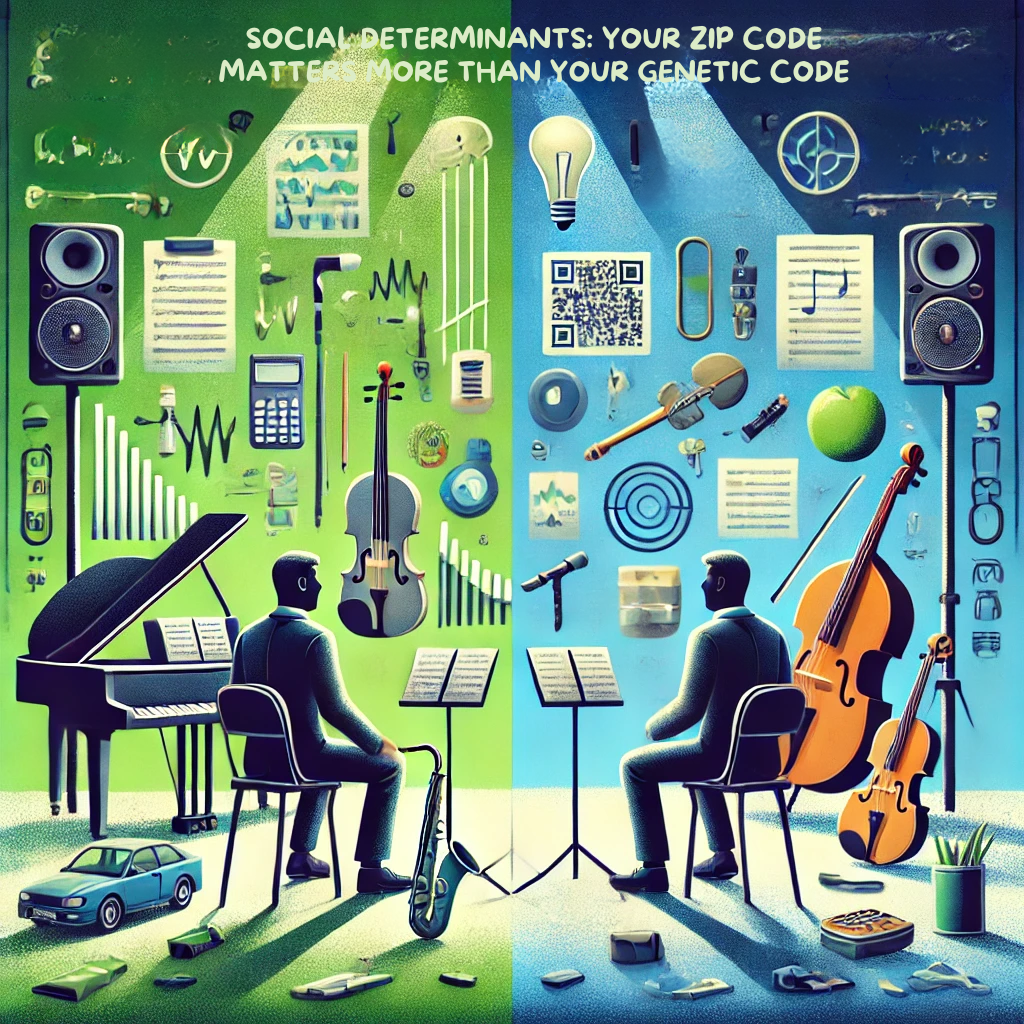
    Think about health like a band trying to make music. Your genetics? That’s just the sheet music. But to actually make that music happen, you need instruments (resources), a place to practice (environment), music education (opportunities), bandmates (community), and a whole support system to keep it all together.

    Some communities got the full orchestra setup – good instruments, proper training, sound-proof practice rooms, supportive music programs. Others? They’re trying to make music with broken instruments, no practice space, cut music programs, and constant noise interference. Before anyone plays a single note, the conditions for success are already unequal.

    Let me break something down for you. When we talk about health, most people think about doctor visits, medications, or their family history. But here’s the real talk: those things only account for about 20% of your health outcomes. The other 80%? That’s what we call social determinants of health – the conditions where you live, work, learn, and play.

    Just like you can’t blame a musician for a bad performance when they’ve got a broken instrument and no place to practice, we can’t talk about health outcomes without looking at the whole system that creates them. And just like music programs in schools? These conditions didn’t happen by accident. They were designed this way.

    Understanding the Band: What Makes Health Happen

    When a band sounds good, it’s easy to focus just on the musicians. But anyone who’s been in a band knows – making good music takes way more than just talent and practice. Let me break down this health orchestra for you:

    Think of social determinants of health like different sections of the band:

    • Economic Stability (The Equipment): Just like you can’t play without instruments, you can’t maintain health without basic resources
    • Healthcare Access (The Sheet Music): Having it available doesn’t help if you can’t read it or reach
    • Education (The Music Lessons): Learning how to play – and how to take care of yourself
    • Built Environment (The Practice Space): Where and how you can actually make it happen
    • Social Context (The Band Members): Who’s playing with you and supporting you

    And here’s the thing about making music – when one part is off, everything’s off. You can be the most talented musician in the world, but if your instrument is broken, your practice space is full of noise, and your music program got cut… well, you see where I’m going with this.

    Let’s dive deeper into two crucial parts of this health symphony: the practice space (our built environment) and music education (our learning opportunities). Because just like in music, these fundamentals can make or break the whole performance.

    The Practice Space: How Environment Shapes the Sound

    Let’s talk about acoustics for a minute. You know how some spaces just make music sound better? While others seem to fight against every note? That’s exactly how our built environment affects our health.

    Think about it: Just like you can’t expect someone to practice violin next to a construction site or create beautiful music in a moldy basement, we can’t expect communities to thrive when their environment works against them.

    Here’s what I mean:

    • Some neighborhoods got perfect acoustics:
      • Clean air to breathe
      • Parks and green spaces
      • Grocery stores with fresh food
      • Safe streets for exercise
      • Easy access to healthcare
      • Good public transportation

    Meanwhile, other communities are trying to make health happen in spaces with:

    • Bad acoustics:
      • Air pollution from nearby highways
      • No safe spaces for physical activity
      • Food deserts for miles
      • Limited healthcare facilities
      • Unreliable public transit
      • Run-down housing with health hazards

    And just like a musician will tell you – it’s not just about one thing being off. That highway noise isn’t just about noise. It’s about:

    • Air quality affecting breathing
    • Traffic making walking dangerous
    • Stress from constant noise
    • Property values affecting resources
    • Community spaces being cut off

    See how one “acoustic” problem creates a whole symphony of health challenges? And here’s the thing – these aren’t natural acoustics. Someone designed these spaces this way. Someone decided where to put the highways, the grocery stores, the parks, and the pollution.

    Music Education: More Than Reading Notes

    Now, let’s talk about learning the music – because just like in health, it’s not just about having access to the notes, it’s about having the support to understand and use them.

    Imagine trying to learn an instrument under these conditions:

    • Your school cut the music program
    • Private lessons cost more than your family makes in a month
    • The only teacher who speaks your language is three towns over
    • You’re working two jobs and can barely find time to practice
    • Nobody in your community has ever played this instrument

    Sound familiar? Because that’s exactly what trying to navigate health information feels like for many communities. It’s not just about “here’s some health pamphlets” or “just Google it.” Real health education is like learning music – it needs:

    • Good Teachers (Healthcare Providers Who Understand Your Context)
    • Proper Learning Materials (Accessible Health Information)
    • Practice Time (Access to Health Resources)
    • Cultural Connection (Health Messages That Resonate)
    • Community Support (People Who Share Your Experience)

    And just like music education isn’t just about reading notes, health literacy isn’t just about reading medical terms. It’s about:

    • Understanding how the whole orchestra (your body and environment) works together
    • Knowing when something sounds off (recognizing health issues)
    • Having the resources to tune up (accessing healthcare)
    • Being able to play with others (navigating health systems)
    • Creating your own music (making informed health decisions)

    Making Music Together: Creating Health Harmony

    So now we see how our practice space (environment) and music education (health literacy) work together. When both are off? It’s like trying to learn violin in a thunderstorm – technically possible, but let’s be real about those odds.

    But here’s the thing about music – and health: Even when conditions aren’t perfect, communities find ways to make it work. Think about how:

    • Blues came from struggle but created beauty
    • Jazz evolved by breaking traditional rules
    • Hip hop turned limited resources into a whole new sound
    • Community choirs make music without fancy concert halls

    Our communities do the same thing with health:

    • Creating food co-ops in food deserts
    • Organizing walking groups for safety
    • Sharing health knowledge through trusted networks
    • Building community gardens in vacant lots
    • Teaching each other to navigate health systems

    But – and this is important – celebrating community resilience doesn’t mean accepting broken systems. Just like we shouldn’t have to rely on school bake sales to fund music programs, communities shouldn’t have to create workarounds for basic health needs.

    What we need is:

    • Better “Acoustics” (Healthy Environments):
      • Clean air and water
      • Safe spaces for activity
      • Access to healthy food
      • Reliable transportation
      • Quality housing
    • Strong “Music Education” (Health Resources):
      • Culturally relevant health information
      • Accessible healthcare
      • Community health workers
      • Health education programs
      • Language appropriate services

    The Final Note: Making Health Harmony Possible

    Let me bring this all home. Understanding social determinants of health is like understanding what it really takes to make music. It’s never just about individual talent or effort – it’s about having the right conditions, resources, and support to make it happen.

    Some communities are forced to perform miracles with broken instruments in noisy spaces, while others have full orchestras and perfect acoustics. That’s not about choice or chance – that’s by design. But here’s the thing about design: what humans design, humans can redesign.

    We need to:

    • Fix the acoustics (improve our environments)
    • Fund the music programs (invest in health education)
    • Maintain the instruments (ensure resource access)
    • Support all musicians (create equitable systems)
    • Let communities conduct their own orchestras (empower local leadership)

    Because at the end of the day, health isn’t a solo performance – it’s a community symphony. And every community deserves the chance to play their best music.

    Ready to join the band? Here’s what you can do:

    • Learn about health conditions in your community
    • Support organizations working for health equity
    • Speak up about environmental health issues
    • Share knowledge with your network
    • Advocate for better health policies

    Remember: Just like music can change how we feel, how we think, and how we move, understanding social determinants of health can change how we approach wellness, how we support our communities, and how we fight for better systems.

    Let’s make some noise for health equity.